
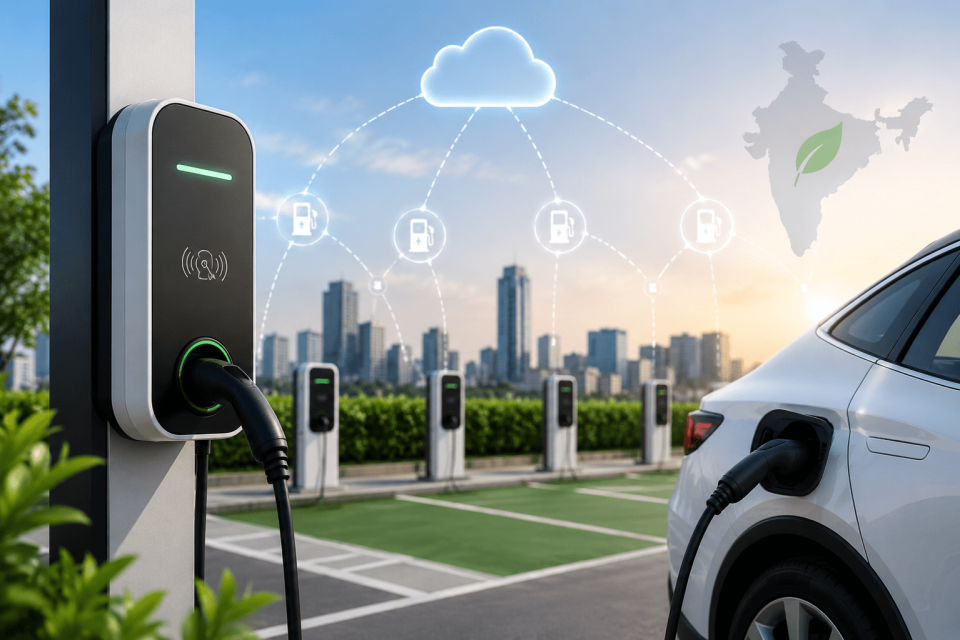
A 4G EV charger connects to the internet through a built-in cellular modem instead of depending on your home or office Wi-Fi. That keeps remote monitoring, app control and software updates working in places where Wi-Fi is weak, which describes many basements, parking areas and outdoor charging bays across India.
What Connected Charging Means
A connected charger communicates with a charger app and a backend system. Through that link, charging status, session history and faults can be seen and managed remotely, rather than only at the charger itself. The connection can run over Wi-Fi, over a cellular network, or both, depending on the product.
Why Cellular Connectivity Helps
Many chargers are installed far from a router. A basement parking level, an open society parking bay or a shared commercial site may have no dependable Wi-Fi at all. A charger with its own 4G connection does not rely on that local network, so the connected features keep working wherever there is mobile coverage.
What a Connected Charger Can Enable
Depending on the product, connected EV charging can support:
- Remote start and stop of charging sessions
- Scheduling and session history
- Fault alerts and remote diagnostics
- Firmware updates delivered over the air
Not every connected charger offers every feature, so check what a specific model actually provides.
Who Benefits Most
Individual owners gain visibility into how and when they charge. Housing societies and businesses gain a way to manage shared chargers without visiting each one. Operators running several chargers gain a single view of what is working and what is not. Connected chargers commonly follow open communication standards such as OCPP, so they can work with charging management software.
What Connectivity Does Not Do
Connectivity does not make a charger charge faster. Charging speed depends on the charger’s output and the vehicle’s onboard charger, not on how the charger connects to the internet.
Three other points are worth checking before you buy:
- Coverage at your site: Mobile signal can vary inside a building or basement.
- SIM and data arrangements: These differ by product and provider, so confirm what is included and whether any subscription applies.
- Offline behaviour: If the connection drops, remote features pause until it returns, so ask how the charger behaves without a connection.
Choosing for Your Situation
Searches for the best EV charger rarely have one universal answer. The right choice depends on where the charger will be installed, how reliable connectivity is at that spot and how you plan to use it. A 4G model is worth considering where Wi-Fi is unreliable or where several users share a charger. For a charger sitting next to a strong home router, Wi-Fi may be all you need.
