
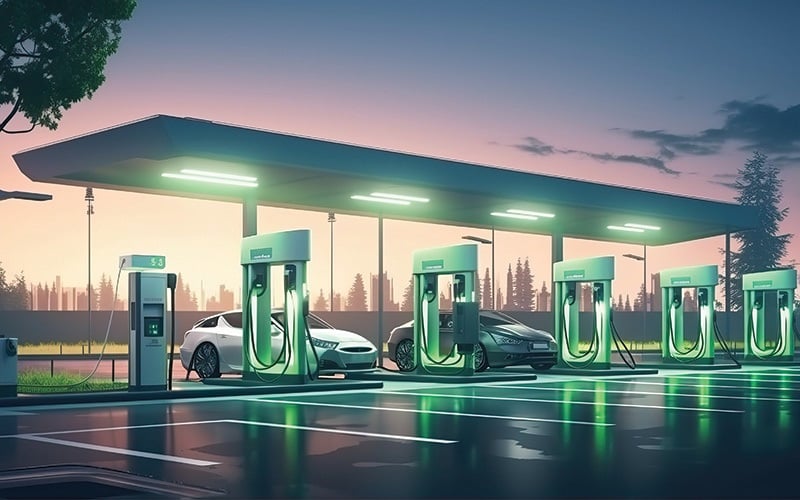
India’s shift toward electric public transportation is not just a policy objective it’s a logistical necessity. With urban congestion rising and clean mobility targets intensifying, the electrification of two and three-wheeler public fleets is at the center of the country’s transport transformation.
But while e-buses and electric rickshaws are hitting the roads in growing numbers, the infrastructure to support them especially DC fast charging stations has often lagged behind. That’s where Blaze DC, a product developed by Bolt.Earth, is beginning to reshape the equation.
1. Charging Built Around Route Schedules, Not Depots
Public fleets operate on tight loops, with little margin for extended charging breaks. Blaze DC’s four performance variants are designed to match this rhythm:
- 3 kW Single Gun – Ideal for individual e-rickshaws or fleet-split use
- 3 kW Dual Gun – Supports two vehicles simultaneously, maximizing real estate
- 6 kW Single Gun – Adds ~80 km in 15 minutes, ideal for urban shared transport
- 12 kW Single Gun – Adds ~120 km in 15 minutes, perfect for high-frequency routes
Unlike traditional setups, Blaze DC enables quick top-ups en route reducing idle time and allowing drivers to stay productive throughout their shift. These DC fast charging stations are not bound to depots; they bring flexibility to roadside stands, metro stops, and public parking lots.
2. Purpose-Built for 2W and 3W Public EVs
Blaze DC is not a one-size-fits-all charger. It’s engineered exclusively for India’s dominant public EV segment two- and three-wheelers.
Compatible with the latest Type 6 and Type 7 connectors, Blaze DC supports over 90% of India’s public EV models, including those from Ather, Ola, Hero Electric, Simple Energy, and more. This universality matters in public transport environments where vehicle diversity is high and downtime is costly.
With Blaze DC, cities can deploy DC fast charging stations that work seamlessly across mixed-brand public fleets without locking into OEM-specific infrastructure.
3. Minimal Maintenance, Maximum Uptime
Public charging can’t afford failure. Blaze DC includes:
- Built-in multi-layer safety protections
- Real-time diagnostics and remote maintenance via Bolt.Earth CMS
- Field Replaceable Units (FRUs) that allow core components to be swapped in minutes by a certified electrician
This ensures that your DC fast charging station isn’t a point of failure it’s a high-availability asset.
4. Government-Backed Cost Efficiency
Through the PM E-DRIVE scheme, operators can claim up to 80% subsidy on public DC fast charging infrastructure. Blaze DC’s 12 kW variant qualifies under this scheme, making it subsidy-ready for state transport units (STUs), urban transit bodies, and charging operators.
With capex recovery of up to ₹80 lakhs per ₹1 crore spent, Blaze DC makes it financially viable to scale DC fast charging stations across cities, bus terminals, and last-mile transit hubs.
5. Backed by a Nationwide Network
Blaze DC is part of Bolt.Earth’s broader charging ecosystem, which spans over 37,000 charging points across 1,700+ cities in India. The company offers integrated CMS software, real-time user apps, and full-stack operational support critical components for public transport agencies navigating the early stages of EV infrastructure deployment.
Final Take
As Indian cities move to decarbonize public mobility, the spotlight is now on solutions that work in the real world on crowded roads, tight timelines, and limited budgets. Blaze DC stands out not just for its speed or size, but for how deliberately it’s been designed around the needs of India’s public 2W and 3W fleets.
For transport departments, shared mobility operators, and urban infrastructure planners, Blaze DC offers a clear path forward: scalable, policy-compliant, and ready for the street.
